Product Planning Suite

A massive research project and design overhaul to GitLab's core product offering, balancing feature and backend improvements while scaling for the future.

Competitive Research Design Strategy Roadmap Planning Design Systems UX Overhaul
Product Planning Suite hero

Results & impact

My responsibilities: Design strategy & research lead

Project timeline: July - September 2025

0 > 1
project kickoff after 3-year stall
2
massive product overhauls
28
criteria prioritization plan
50m +
active users

The challenge

We don't want to spend a ton of money on GitLab when the functionality just doesn't meet other platforms. The DevOps is great for what we need, but the workflow management's lack of features doesn't justify switching from [competitor].
- GitLab enterprise customer


The core need: Rebuild alignment across design, product, and engineering to deliver a long-overdue overhaul of GitLab's planning experience.

When I joined the team, this project had been stalled for over three years. New leadership had pulled the rug out from under an existing plan, and my PM and I had to make the case for why these changes still mattered. So, how might we resurrect a years-stalled project, realign a fragmented team, and deliver a foundational redesign all at once?

To start, my PM and I planned, conducted, and analyzed a competitive analysis spanning 28 criteria across 15 competitors. This list was built from customer calls, user interviews, and churn signals. The results were categorized into four tiers of priority, and we worked alongside engineering to layer in effort estimates and technical constraints against each of the 28 items, reworking the original plan into something everyone could commit to.

With alignment secured, the project took shape around two interconnected deliverables:

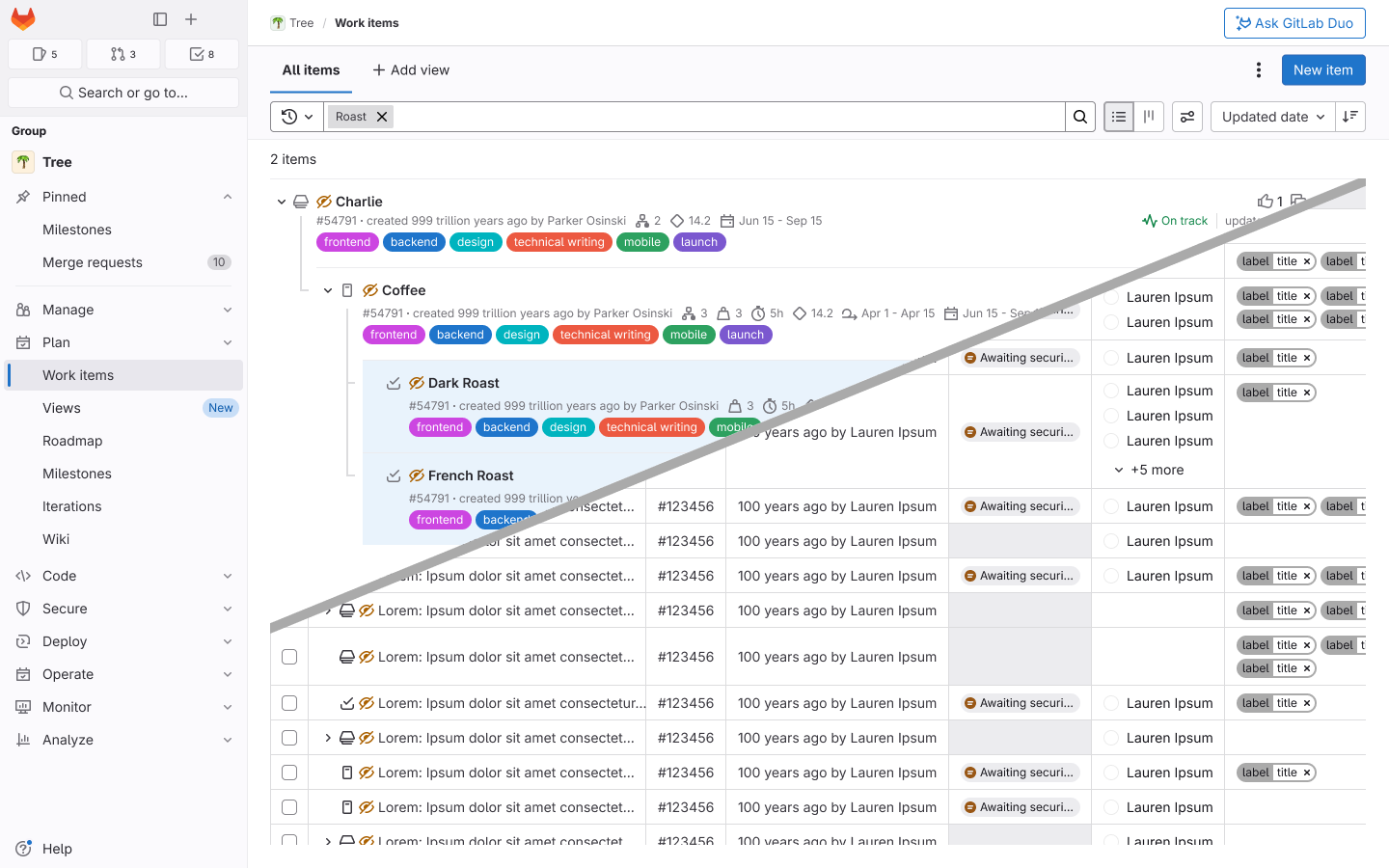
Nested Listing Pages: Redesign GitLab's existing planning list pages to support the new Work Items framework - a consolidation of issues, epics, tasks, and OKRs into a single unified list. The redesign introduced nesting for the first time, surfacing ancestor-parent-child relationships between items and requiring a foundational rethink of how search, filtering, and grouping worked.

Table View: Design an entirely new way to browse and manage planning data: a spreadsheet-like table view where each piece of item metadata could be edited inline, cell by cell. This brought its own challenges around sorting, display logic, and information density, while also inheriting every complexity of the nesting problem.
Design process

1
Discovery & Research
Conducted customer calls and user interviews to understand where GitLab's planning experience was falling short and what tools users were turning to instead. This research built the foundation for our criteria list and competitor set.
2
Market Research
Evaluated 28 criteria across 15 competitors, scoring each based on complexity and depth of implementation. This gave us a clear, evidence-backed picture of where GitLab stood relative to the market.
3
Prioritization Plan
Used the competitive analysis results to build a tiered roadmap, weighted by competitor prevalence and customer need. This translated raw research into a clear, defensible plan of action.
4
Realignment & Planning
Presented the prioritization plan to the engineering manager and used the research to rebuild team alignment. Design, product, and engineering then collaborated to map priorities, constraints, and timelines into a unified plan.
5
Design & Iterate
Began designing the two foundational surfaces — Nested List Pages and Table View — starting with the most complex shared challenges: grouping, filtering, searching, sorting, and configuration.
× Full size image